Growing up, I was taught more than a little about jazz. Not enough to consider myself an expert, but I heard a lot of it.
The teacher? My dad. Every Sunday morning, Dad would sleep in, requiring me and my sister to move about the house quietly. I usually wound up just playing in my room.
Sis and I knew we could move freely when we heard the needed drop on Dad’s record player, located down the hall in the family room. Seconds later, jazz began to emanate from the speakers.

Sometimes, the jazz was acoustic (or “straight ahead”). Other times, the instruments were electric (aka “fusion”). Whatever it was, it was my job as a child to ignore it.
Around 1978, when I was 11 or 12, I was all about rock and roll and R&B, like all my other friends. But one particular Sunday, I walked into the jazz-filled family room on my way to the kitchen. As usual, I was trying to ignore what I was hearing. Except this time, I couldn’t.
Something was coming out of those speakers that grabbed and held my attention. It sounded like rock. There were guitars, the bass was electric, and the drums were very heavy. Only there was an added element. I couldn’t put my finger on it.
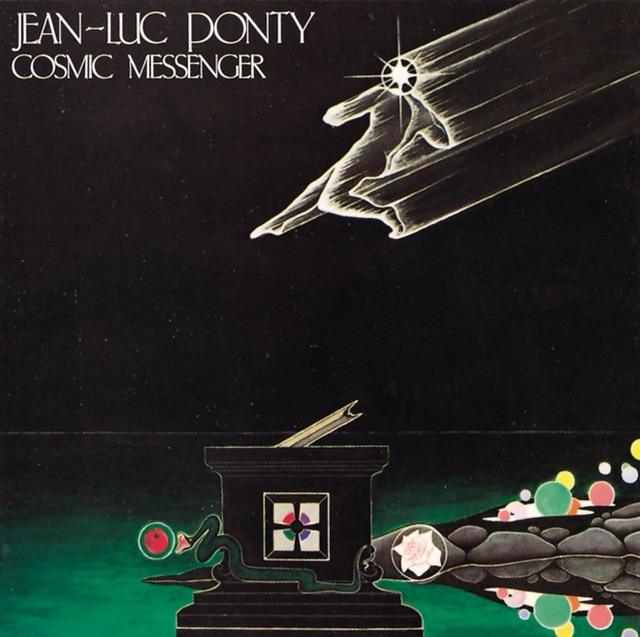
I asked Dad what it was. “It’s an electric violin,” he told me. “It’s being played by a man named Jean-Luc Ponty.” I was transfixed. The album was called Cosmic Messenger. I went from not listening to sitting next to Dad on the couch. I could see his smile out of the corner of my eye.
I had my own stereo system. Before long, records started magically appearing on top of my record player. Ponty, Stanley Clarke, Return to Forever, Weather Report … I dug on them hard! I was a fan.
It took a while longer for straight-ahead jazz to reach me. Dad would always go on and on about Miles Davis. Oddly, he never mentioned his electric music.^ I, meanwhile, had joined the Columbia House record and tape club (ask your friends or parents). One of the first record I got was from Miles Davis. It was called Tutu. Very electric. Very funky. Very interesting. Once again, I was hooked.

That album got me to obtain a box set of Miles’s called The Columbia Years, and that’s where I was finally exposed to straight ahead jazz via legendary albums like Kind of Blue. Soon after, I was headed down yet another rabbit hole, checking out traditional jazz albums from Wynton and Branford Marsalis, Wayne Shorter, and John Coltrane.

I’ve been asked by friends (on more than one occasion) how they could go about “getting into” jazz. I always seemed to be recommending the same songs and albums. At last, I decided to put them together on a playlist.
So, if you’re interested in exploring jazz, here are a couple of good places to start. Be it acoustic:
https://open.spotify.com/playlist/30lzprYOXKovYiQ1o5LAQq?si=MCJqVcnISm-bfElgmvj7qQ&pi=u-d_NV-hr2TU6H
Or electric:
https://open.spotify.com/playlist/1ehtkU4i6BaJgO6hV5oKZy?si=PareGc9aRh-zv_3Bif5XAQ&pi=u-7vQeiAwsRJaV
I hope you find this helpful. Enjoy!
^ Dad had copies of Miles Davis’s electric albums Bitches Brew and On the Corner. Something tells me they were too much for him. I, of course, love them both.
#cirdecsongs
If you would like to have your music reviewed, contact me at cirdecsongs@gmail.com
 CirdecSongs